
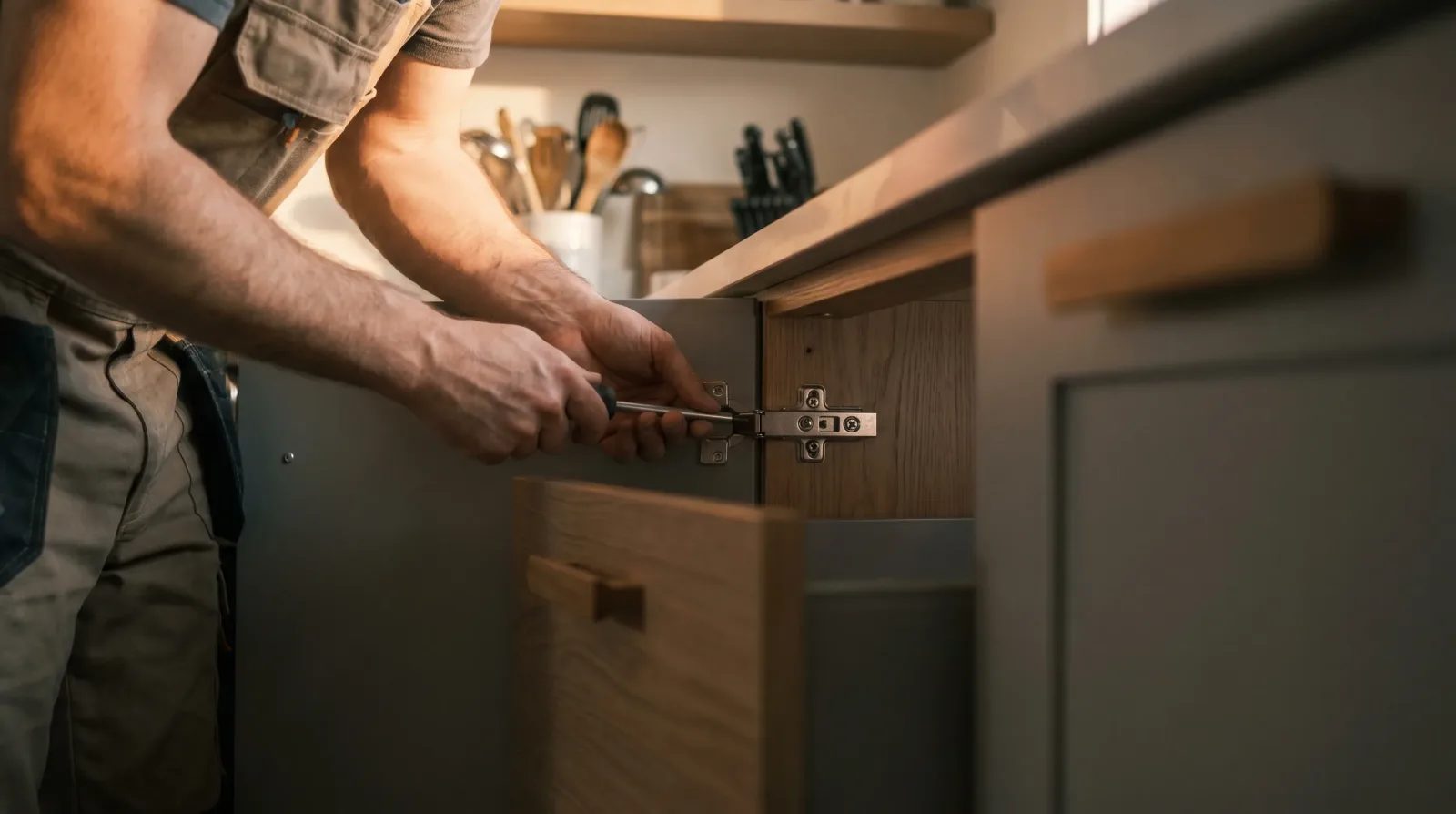
There is a moment in most BC kitchens, usually around year five or six, when cabinet doors stop closing flush. One door sits a little proud. Another slams instead of settling. A drawer scrapes when it slides home. The instinct is to assume the cabinets are failing and start pricing a refresh. The truth is most of those symptoms are 30 minutes of hinge adjustment away from being fixed.
What actually causes cabinet doors to drift
Cabinet doors hang on European-style cup hinges in 90% of homes built since the 1990s. Those hinges have three small adjustment screws, one each for height, depth, and side-to-side alignment. Over years of use, doors sag a millimetre at a time as wood breathes through BC's wet winters and dry summers, the cabinet boxes shift slightly with the house, and hinge screws loosen under repeated open-and-close cycles. Each by itself is invisible. Together, they add up to misaligned doors.
1. The three-screw alignment routine
- Height adjustment: the screw closest to the cabinet moves the door up or down a few millimetres in either direction.
- Depth adjustment: the middle screw pulls the door toward or away from the cabinet face. This is what fixes a door sitting proud.
- Side-to-side adjustment: the screw farthest from the cabinet moves the door left or right. This is what aligns adjacent doors so the gap between them is even.
Brody adjusts all three on every door of a misaligned bank in roughly 20 minutes. The result is a kitchen where every gap is consistent, every door closes flush, and the cabinetry suddenly looks intentional again.
2. When to retrofit soft-close hinges
If your cabinets are 10 to 20 years old and the doors slam, you almost certainly do not have soft-close hinges. They became standard around 2010. Retrofitting is straightforward: most European cup hinges accept a soft-close clip-on adapter that drops into the existing hinge cup. Higher-end retrofits replace the hinge entirely with a Blum or Salice soft-close hinge that gives the door a controlled close every time.
Soft-close drawers work the same way. Most older drawer slides accept a soft-close adapter that snaps onto the back of the slide. Better still is replacing the slides with full-extension soft-close runners, which gives both quieter operation and easier access to whatever lives in the back of the drawer.
3. When alignment is not the answer
There are limits to what hinge adjustment can fix. If the cabinet box itself is racked because of a settled floor or a leak that swelled the side panel, no amount of hinge work will land doors true. If the hinge holes themselves are stripped from years of slamming, the door may need a hinge plate replacement or a small wood repair before the screws will hold. Brody confirms which category your cabinets fall into during the visit, so the work matches the actual problem.
4. Hardware swaps that lift the whole kitchen
If the cabinets themselves are sound but the hardware feels dated, swapping every pull and knob in the kitchen is the cheapest visible upgrade in home renovation. Twenty pulls and ten knobs takes Brody about two hours, and the change is the difference between a 2008-finish kitchen and one that reads current.